

Journal
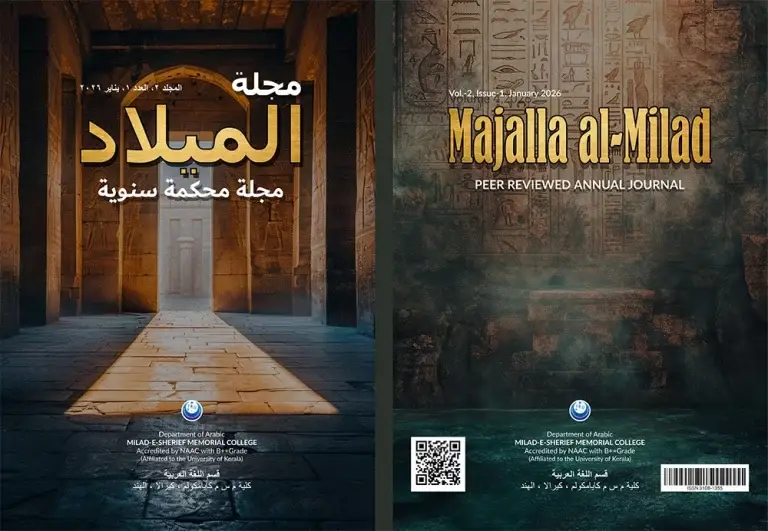
majalla al-milad
Majalla al-Milad Journal of Arabic literature, published by the Department of Arabic at MSM College, Kayamkulam, is committed to advancing high-quality research in the fields of Arabic language, literature and culture. This journal provides an inclusive platform for scholars, researchers, and practitioners to share their findings and insights across these areas of study. Majalla al-Milad prioritizes emerging perspectives in Arabic language, literature and culture by encouraging research that addresses both regional and global contexts. The journal upholds rigorous ethical standards in publishing, emphasizing originality, integrity and transparency. It is envisioned as a peer-reviewed, open-access journal, available annually in Arabic and English.
Frequency of Publication: Annual
Subject: Literature
Languages: Arabic and English
Starting Year: 2024
Format of Publication: Online
Publisher Information
Publisher: Dr. Farook S
Head of the Department of Arabic
MSM College, Kayamkulam – 690502, Kayamkulam Municipality, Alappuzha District, Kerala State, India
Email: arabic@msmcollege.in, almilad@msmcollege.in
Mobile: +91 9895244420
Chief Editor
Dr. Farook S.
Head of the Department of Arabic
MSM College, Kayamkulam – 690502, Kayamkulam Municipality, Alappuzha District, Kerala State, India
Email: farook@msmcollege.in
Mobile: +91 9895244420
Majalla al-Milad_January_2026_Vol.2_Issue 1
Vision
Enriching Society through an Inclusive and Enlightened Arabic Literary Culture
“Enriching Society” aims to foster an Arabic literary culture:
- that is rooted in cultural heritage while embracing modern perspectives
- that offers a meaningful and aesthetically enriching experience for readers
- that reaches audiences across all social and economic backgrounds
- that informs, inspires, and uplifts communities through language and literature
“An Inclusive and Enlightened Culture” envisions:
- A society where moral and intellectual values are upheld
- A world where justice and equity are accessible to all
- A community that values empathy, respect, and shared growth
Mission
Our mission is to promote comprehensive research in Arabic literature.
We aim to:
- Provide a collaborative platform for scholars, researchers, and practitioners to share knowledge and insights.
- Encourage research that explores both traditional and contemporary perspectives within regional and global contexts.
- Uphold ethical standards, ensuring academic integrity, originality, and transparency in all published work.
- Advance academic and cultural understanding through accessible, peer-reviewed publications that bridge diverse perspectives in Arabic studies.
Submission Guidelines
Authors are requested to ensure their submissions meet the following requirements:
Majalla al-Milad Journal of Arabic literature accepts original research articles that align with the journal’s aims and scope.
The submission must not have been previously published nor be under consideration by any another journal.
Manuscripts should follow the guidelines of the 7th edition of the Publication Manual of the Modern Language Association (MLA).
Arabic or British English spelling and grammar should be used consistently throughout the manuscript, depending on the language of submission.
Author Guidelines
Format:
Authors should submit original research articles in the following format:
- Title Page
- Abstract & Keywords
- Structured Research Article
- Author’s Biography
- Declaration Statements
Title Page:
Manuscripts should include a title page with only the article title, author(s)’ names, affiliations, official addresses, phone numbers, and email addresses. The author(s)’ name should not appear on any other page. Clearly indicate the corresponding author responsible for all publication communications.
Abstract:
The abstract should be 150–200 words, providing a concise introduction to the topic and a non-technical summary of the main findings and their implications. Avoid references, sections, or subheadings.
Keywords:
Provide four to six keywords for indexing purposes, reflecting the main content of the submission.
Manuscript:
The manuscript should be between 3,000 to 6,000 words, typed in MS Word, single-spaced, using 16-point Saqal Majalla (Arabic) and Times new roman (English) fonts. Place all illustrations, figures, and tables within the text at appropriate points rather than at the end.
Endnotes:
Use serial numbers for all notes within the text, with detailed references as endnotes before the reference list. Endnotes are optional.
References:
Include a reference list after the endnotes, arranged alphabetically by the surname of the first author. Only works cited in the main text should be listed.
Peer Review:
All submissions will undergo a peer review process, with acceptance based on reviewers’ recommendations.
Author’s Biography:
Provide a brief biographical sketch of 60–80 words, including current designation, affiliation, areas of specialization, and the number of books or journal articles published.
Submission:
Manuscripts should be electronically submitted to almilad@msmcollege.in
Declaration Statements:
- Originality: Each submission must include a declaration confirming the article’s originality and that it has not been published or submitted elsewhere.
- Conflicts of Interest: Authors must disclose any competing interests or confirm that none exist.
- Financial Support: Authors must list any financial support received, including funds, grants, or other assistance in preparing the article.
There are no fees for publishing in either the online or printed versions of the journal.
Call for Papers
We invite you to submit your original research papers to Majalla al-Milad Journal of Arabic literature, an open-access journal publishing articles between 3,000 and 6,000 words. We welcome both qualitative and quantitative studies on topics related to Arabic language and literature.
Editorial Board
Majalla al-Milad Journal of Arabic literature is committed to fostering diversity in gender, expertise, and geographical representation within its Editorial Board and Peer Reviewers. Our board members are experts in Arabic language and literature, offering a variety of perspectives from both national and international contexts.
Chief Editor
Dr. Farook S., Head, Department of Arabic, MSM College, Kayamkulam, Alappuzha Dt. Kerala – 690502, India,
Institutional Profile Link: http://msmcollege.in/departments/arabic/
Email: almilad@msmcollege.in, farook@msmcollege.in
Editorial Board:
- Prof.(Dr). Muhammed Thaha, Principal, MSM College, Kayamkulam, Alappuzha Dt. Kerala – 690502, India,
Email: dramthaha@msmcollege.in
Mobile: 9995115954
Institutional Profile Link: http://msmcollege.in/departments/arabic/ - Dr. Harsha Viswanath, Asso. Professor, Dept. of English, MSM College, Kayamkulam.,
Email: harshaviswanath@msmcollege.in
Institutional Profile Link: http://msmcollege.in/departments/english/ - Dr Zameer K. H., Asst. Professor, Department of Arabic,
Email: zameer@msmcollege.in
Mobile: 8921498204
Institutional Profile Link: http://msmcollege.in/departments/arabic/ - Dr Asharafudeen A., Asst. Professor, Department of Arabic,
Email: drasharafudeen@msmcollege.in
Mobile: 8129991429
Institutional Profile Link: http://msmcollege.in/departments/arabic/ - Anwar Hussain A., Asst. Professor, Department of Arabic,
Email: anwarhussain@msmcollege.in
Mobile: 9496344214
Institutional Profile Link: http://msmcollege.in/departments/arabic/ - Dr Shanil A., Asst. Professor, Department of Arabic,
Email: shanil@msmcollege.in
Mobile: 9947785086
Institutional Profile Link: http://msmcollege.in/departments/arabic/ - Ramshad Rahim, Asst. Professor, Department of Arabic,
Email: ramshad@msmcollege.in
Mobile: 7012049277
Institutional Profile Link: http://msmcollege.in/departments/arabic/
Advisory Board
- Al Haj P. A. Hilal Babu, Governing body chairman, MSM College Kayamkulam.
- Dr. Leila Labidi, Asst. Professor, Department of Arabic Language & Literature, University of Sharjah, UAE
- Dr. Safeer C K, Faculty, Dept. of Physics, University of Oxford, U.K.
- Dr. Ismail Olayikkara, Principal & Professor, Sir Syed College, Taliparamba.
- Dr. Muhammad Ali Askar, Asso. Professor Department of Arabic, University College, Thiruvananthapuram.
- Dr. Noushad V., Asst. Professor & Head, Department of Arabic, University of Kerala, Thiruvananthapuram.
- Dr. Abdul Latheef E., Asso. Professor, Department of Arabic, Govt. College, Chavara.
- Dr. Muthu U.T., Asst. Professor, Department of Communication, S. J. College of Communication, Changanassery.
Peer Review Board
- Prof. (Dr.) Ubaid A., Professor & Head (Rtd), University of Kerala, Thiruvananthapuram.
- Prof. (Dr.) M. N. Khan, Professor, Department of Arabic, Delhi University, New Delhi.
- Dr. Muhammad Abid U P, Assistant Professor, Department of Arabic, Farook College, Calicut
- Dr. Aboobacker K., Assistant Professor, Department of Arabic, R U A College, Calicut.
- Dr. Muhammad Musthafa, APT BLK 62B, Strathmore Avenue, #07 -60, Singapore,143062
Copyright Policy
Copyright © 2024 Department of Arabic, MSM College, Kayamkulam – 690502, Kerala, India. All rights reserved. No part of the content may be reproduced in any form without prior written permission from the publisher.
Disclaimer:
The publisher makes no guarantees regarding the accuracy, completeness, or currency of the content. The publisher shall not be held liable for any losses, claims, or damages resulting from the use of this material, whether direct or indirect.
Opinion Disclaimer:
The views expressed in the articles are those of the authors and do not necessarily represent the views of the publisher.
Peer Review Policy
- Manuscripts will be assigned to reviewers based on their expertise in the relevant field.
- Manuscripts submitted for publication undergo rigorous evaluation by at least three experts for ensuring quality and employing a meticulous peer-review system.
- Reviews should be submitted within the specified timeframe to ensure timely publication.
- Manuscripts will be reviewed objectively, keeping in mind the importance of scientific integrity and ethical considerations.
- The reviewing process will be maintained with strict confidentiality regarding the content of the manuscripts reviewed.
- Reviewers will provide clear, constructive, and unbiased feedback to help authors to improve their work.
- Reviewers will indicate whether the manuscript meets the journal’s standards and if it should be accepted, revised, or rejected.
Plagiarism Policy
Majalla al-Milad Journal of Arabic literature, published by the Department of Arabic at MSM College, is firmly against any unethical acts of copying or plagiarism in any form. Plagiarism is defined as the act of copying significant portions of a manuscript from previously published resources.
All manuscripts submitted for publication to Majalla al-Milad Journal of Arabic literature, will be cross-checked for plagiarism using duplication-checking software. A maximum similarity index of 10% is allowed.
Proper citation is required for all images, figures, and tables reproduced from external sources.
The following types of plagiarism are recognized by Majalla al-Milad Journal of Arabic literature,
- Full Plagiarism: This occurs when previously published content is used without any changes to the text, idea, or grammar. It involves presenting the exact text from a source as one’s own work.
- Partial Plagiarism: If the content is a combination of text from multiple different sources, and the author has extensively reproduced the material, it is considered partial plagiarism.
- Self-Plagiarism: This occurs when an author reuses entire or portions of their previously published research. Complete self-plagiarism refers to when an author republishes their previously published work in a new journal or magazine.
Open Access Policy
The journal is committed to open access, ensuring that all articles are freely available to the public immediately upon publication. There are no subscription fees or paywalls, and the journal retains the copyright of the respective authors.
Ethical Guidelines
- The ethical guidelines are designed to promote integrity, transparency, and accountability in research and publication. Authors, reviewers, and the editorial team must follow these principles to maintain high ethical standards in scholarly communication.
- Ensure originality and proper attribution by avoiding plagiarism or self-plagiarism and using correct citations.
- Accurately represent all significant contributors as authors and communicate any changes to authorship.
- Conduct research with integrity, providing transparent methodologies, data, and analysis to allow reproducibility. Avoid data manipulation or fabrication.
- Obtain informed consent from participants and protect their rights, privacy, and confidentiality. Handle personal information securely and in compliance with privacy laws.
- Ensure independent and impartial review and publication, with editorial decisions based on quality, relevance, and rigour, regardless of the authors’ backgrounds.
- Disclose any conflicts of interest that could affect objectivity.
Articles
Majalla al-Milad_January_2026_Vol.2_Issue 1
البعد البيئي واإلنساني في قصة “دومة” لوجدي األهدل
Dr. Zameer KH
الطبالشعبيالعربي:دراسةتحليليةفيممارساتالتداوي التقليدي وسياقاتها الثقافية
Abubakr B. U.
أثر الفلسفة اليونانية على الفلسفة اإلسالمية
Dr. Muhammed Sirajudheen T
الشيخ أبو الحسن علي الندوي وأدب الأطفال
Zainudheen C
مدرسة الديوان وابراهيم عبد القادر المازني: رؤية نقدية وأدبية
Dr. Asharafudeen
الشيخ أبو الحسن علي الحسني الندوي و دوره في نشر السلام بالهند
” حركة رسالة الإنسانية ” نموذجا
Dr. Umair Khan al-Ma‘bari,
Dr. Izz al-Din al-Nadwi
الرمزية في شعر محمود درويش: المكان والطبيعة والتاريخ والدين كأدوات للهوية والمقاومة
Ismail Kunju
Dr. Asharafudeen
تجليات الرؤية الصوفية في شعر عبد الوهاب البياتي
Dr. Farook S
التطورات البنيوية والثقافية وتأثيرها على المبادرات النسوية في العالم العربي
Dr. Shanil A
المقاومة والمنفى في الأدب العربي الحديث في فلسطين
Dr. Muhammed Bava P
الشباب التونسي بين الواقع والتمثيل السينمائي: دراسة حول فيلم “وين ياخذنا الريح”
Mr. Anwar Hussain
تحولات الحكم في سوريا من حافظ الأسد إلى ما بعد بشار الأسد
Farhana Kamal
Dr. Farook S
Dr. Harsha Viswanath
Confession in Exile: Mapping Feminine Consciousness in Anamika and Nazik al-Mala’ika
Dr.Reshma Surendran
Dr. E. Najeem
Dr. Jayalekshmi B
Whispers of the Displaced: Reimagining Power through Kalila
wa Dimna
Dr. E. Najeem
Misogynistic Portrayal of Women in Select Indian Advertisements
Dr Vidya Rajagopal
Dr.Biju R I
Plural Spaces of Gender and Identity in Bhutan: A Study on Select Women’s Narratives
Rashmi S. Pillai
Vol. 1 , No.1(2024) Majalla al-Milad_August_2024_Vol.1_Issue 1
دعاية القرآن إلى حماية البيئة
Dr. Zameer KH
العرب والطب
Dr. Thazni
أهمية األلفاظ في شعر البياتي
Dr. Farook S
دور ابراهيم عبد القادر المازني في الرومانسية
Dr. Asharafudeen
الدكتور محيي الدين األلوائي آثاره و مساهماته في اللغة العربية والعلوم اإلسالمية
Prof. Muhammed Thaha
مسهامات حنا مينا في الرواية العربية
Miss Farhana Kamal
Archives
Vol. 1 , No.1(2024) Majalla al-Milad_August_2024_Vol.1_Issue 1
دعاية القرآن إلى حماية البيئة
Dr. Zameer KH
العرب والطب
Dr. Thazni
أهمية األلفاظ في شعر البياتي
Dr. Farook S
دور ابراهيم عبد القادر المازني في الرومانسية
Dr. Asharafudeen
الدكتور محيي الدين األلوائي آثاره و مساهماته في اللغة العربية والعلوم اإلسالمية
Prof. Muhammed Thaha
مسهامات حنا مينا في الرواية العربية
Miss Farhana Kamal
Contact Information
Chief Editor
Majalla Al-Milad
Department of Arabic
MSM College, Kayamkulam 690502
almilad@msmcollege.in
